

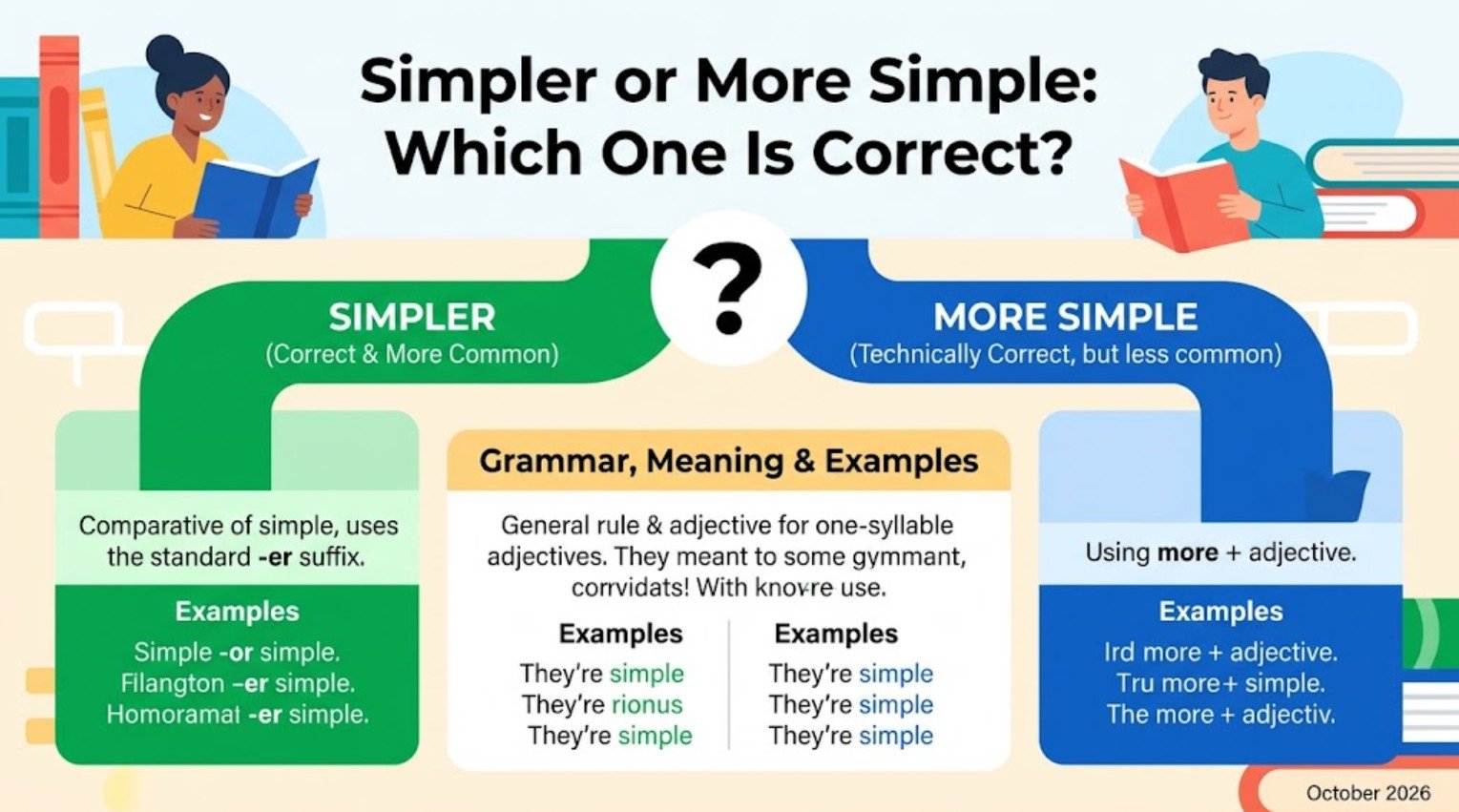
If you are unsure whether to say “simpler or more simple,” you are dealing with a common English grammar question. Both forms can be grammatically correct, but they are not equally common in everyday English.
The usual comparative form of simple is simpler. Major dictionaries list simpler as the standard comparative form, while Oxford also notes that more simple can be used in some contexts.
Simpler or More Simple: Which Is Correct?
Simpler is generally the better choice when you are comparing two things. It is the normal comparative form of the adjective simple, just as smaller is the comparative form of small. Cambridge’s grammar guidance specifically gives simple → simpler → simplest as an example of an adjective that can take the -er and -est endings.
For example, you would normally write:
- This method is simpler than the old one.
- The new instructions are simpler to follow.
- We need a simpler solution.
- Her explanation was simpler than mine.
In each sentence, simpler means that something is less complicated or easier to understand or do. Cambridge defines simple in this sense as something that is easy to understand or do and not difficult.
More simple is not automatically incorrect. Oxford lists more simple and most simple as possible alternatives to simpler and simplest. However, in ordinary writing and conversation, simpler will usually sound more natural.
Why Is “Simpler” the Usual Choice?
English forms many comparative adjectives by adding -er to the adjective. With simple, the normal pattern is:
Simple → Simpler → Simplest
The base form describes something without making a comparison. The comparative form compares two things, while the superlative form identifies the highest degree among three or more things.
For example:
This is a simple explanation.
There is no comparison in that sentence. If you compare it with another explanation, you can say:
This explanation is simpler than the previous one.
If you compare several explanations and identify the easiest one, you can say:
This is the simplest explanation.
Cambridge’s grammar guidance confirms that simple can take the -er and -est endings.
The word simple is also commonly used to describe things that have few parts, are not complicated, or are easy to understand. That makes simpler especially natural when comparing processes, instructions, explanations, designs, systems, and solutions.
When Can You Use “More Simple”?
More simple can be used in English, even though simpler is usually preferred. Oxford specifically recognizes more simple as an alternative comparative construction. This means it should not automatically be classified as grammatically wrong.
For example:
The new version is more simple than the original.
The sentence is understandable and grammatically possible. However, most writers would probably choose:
The new version is simpler than the original.
The second version is shorter and more natural.
There can also be situations where a writer chooses more simple because of the rhythm or structure of a sentence. English does not require every adjective to use exactly one comparative pattern. Some adjectives normally use more, while others commonly use -er. Cambridge explains that adjective comparatives can follow different patterns depending on the adjective.
For simple, however, simpler is the clearest default choice.
Simpler vs. More Simple in Sentences
Consider these examples:
The new process is simpler than the old process.
This is the most natural version for normal writing.
The new process is more simple than the old process.
This is also possible, but it sounds less natural to many English speakers.
The same distinction applies to everyday descriptions:
This recipe is simpler than the one I used yesterday.
The instructions are simpler now.
We need a simpler way to explain the problem.
These examples use simpler because the speaker is directly comparing levels of difficulty or complexity.
You should also distinguish simpler from more simply. Simpler is an adjective, while more simply is an adverbial expression.
Compare:
We need a simpler explanation.
Here, simpler describes the noun explanation.
Please explain the problem more simply.
Here, more simply describes how the explanation should be given.
The difference is small but important when choosing the correct form.
Common Grammar Mistakes to Avoid
One of the most common mistakes is combining the two comparative forms:
Incorrect: more simpler
Correct: simpler
Also possible: more simple
You should not normally use more together with the -er ending. The two forms both express comparison, so using both creates an unnecessary double comparative.
Another mistake is confusing simple, simpler, and simplest. Use simple when there is no comparison, simpler when comparing two things, and simplest when identifying the highest degree among three or more things.
For example:
- This is a simple solution.
- This solution is simpler than the first one.
- This is the simplest solution of the three.
The same pattern works with many other adjectives:
- small → smaller → smallest
- fast → faster → fastest
- quiet → quieter → quietest
- simple → simpler → simplest
The important point is that simple follows the -er/-est pattern naturally. Cambridge’s grammar guide specifically includes simple, simpler, simplest among adjectives that can form comparatives this way.
Which Should You Use in Formal Writing?
If you are writing an email, academic assignment, website article, report, business document, or other formal content, simpler is usually the safest and most natural choice.
For example:
We need a simpler solution to the problem.
This sounds concise and professional.
Instead of:
We need a more simple solution to the problem.
The second sentence is not necessarily grammatically wrong, but the first is more idiomatic.
This preference is also supported by dictionary usage. Oxford gives simpler as the comparative form before noting that more simple is another possible construction.
That does not mean you need to eliminate every occurrence of more simple. If a sentence naturally calls for it, the construction can be acceptable. The key is understanding that simpler is the standard first choice, not assuming that more simple is always incorrect.
Conclusion
So, when deciding between “simpler or more simple,” the best general answer is simpler. It is the standard comparative form of simple and is normally the more natural choice in everyday and formal English.
More simple is also possible in certain contexts, and major dictionaries recognize it. However, if you are unsure which form to use, choose simpler.
The basic pattern is easy to remember:
Simple → Simpler → Simplest
And avoid the unnecessary double comparative “more simpler.”
FAQs
Is “simpler” grammatically correct?
Yes. Simpler is the standard comparative form of simple and is usually the preferred choice.
Is “more simple” correct English?
Yes. More simple can be grammatically acceptable, although simpler is generally more natural.
Should I say “simpler” or “more simple”?
In most situations, use simpler. It is shorter and is the usual comparative form.
Is “more simpler” correct?
No. Use simpler or, where appropriate, more simple, but do not combine them as more simpler.
For More Visit First Read
